


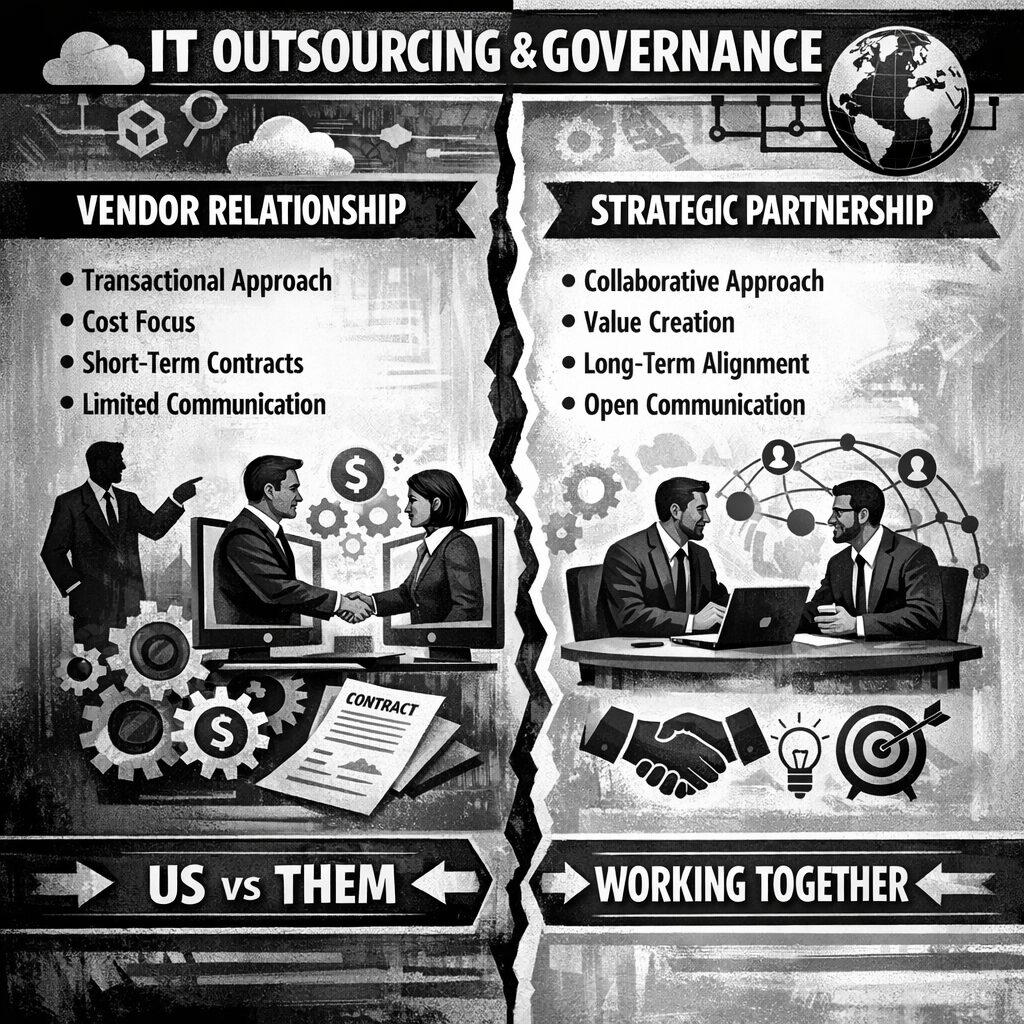
A few years ago, I walked into an organization where the IT outsourcing relationship was on fire. Tickets were piling up. The staff was frustrated. Leadership was ready to terminate the contract and find a new vendor.
So I asked the executive team one question:
“Can you show me the governance structure for this relationship?”
Silence.
No regular business reviews. No escalation framework. No agreed-upon KPIs beyond ‘keep the lights on.’ No one on the client side owned the relationship.
They had hired a vendor — and then walked away.
Here’s what 25 years of leading IT across manufacturing, higher education, life sciences, and global enterprises has taught me:
Outsourced IT fails not because the vendor can’t do the work.
It fails because the client never defined what success looks like.
Think about it: if you hired a general contractor to renovate your office but never gave them blueprints, never checked in, and never assigned someone to approve decisions, would you blame the contractor when the result isn’t what you wanted?
That’s exactly what happens with IT outsourcing every single day.
Three things I always tell business leaders before they sign (or renew) a managed services contract:
1. You can outsource the work. You cannot outsource the accountability.
Someone internal — ideally at the executive level, but not the president — needs to own this relationship. Not ‘keep an eye on it.’ Own it.
2. If your only KPI is uptime, you’re already behind.
Uptime is table stakes. The real question is: Is IT enabling your business strategy, or just preventing disasters? Do you even have a strategy for aligning IT with your overall business? Those are very different conversations.
3. Governance isn’t bureaucracy — it’s the relationship itself.
Monthly business reviews, quarterly strategic check-ins, and clear escalation paths. These aren’t overhead. They’re the difference between a partnership and a transaction.
That organization I mentioned? We didn’t replace the vendor. We built a governance framework, appointed an internal IT liaison, and aligned the service delivery to actual business priorities.
Six months later, the same vendor — same team, same contract — was getting praised in board meetings.
The technology didn’t change. The leadership did.
If you don’t have that person yet, start with a fractional CIO or vCIO — someone senior enough to own the vendor relationship and align it with your business strategy. That single move can transform the entire ROI of your IT investment.
—
Whether you run IT in-house, outsource it, or blend both, the lesson is the same: technology is only as effective as the leadership around it.
That’s true whether you’re a 350-person college or a $2.5B global manufacturer.
hashtag#ITLeadership hashtag#ManagedServices hashtag#ITOutsourcing hashtag#CIO hashtag#fractional hashtag#ServiceDelivery hashtag#HigherEducation hashtag#DigitalTransformation